

Channel Sounding Demo#
The Channel Sounding demo showcases how to measure distances between a smartphone and a reflector using Bluetooth Channel Sounding. This feature enables precise distance and direction measurement between Bluetooth devices, improving accuracy compared to traditional RSSI-based methods.
The EFR32xG24 Development Kit functions as the Channel Sounding Reflector device, while the smartphone acts as the Channel Sounding Initiator. The initiator estimates the distance, and the estimated values are also available on the reflector side.
Users interact with the smartphone which functions as the CS Initiator, while the Channel Sounding Development Kit (BRD2606A board) operates as the CS Reflector (CS RFLCT). Once the setup is complete, the channel sounding operations can commence.
EFRxG24 Dev Kit Setup#
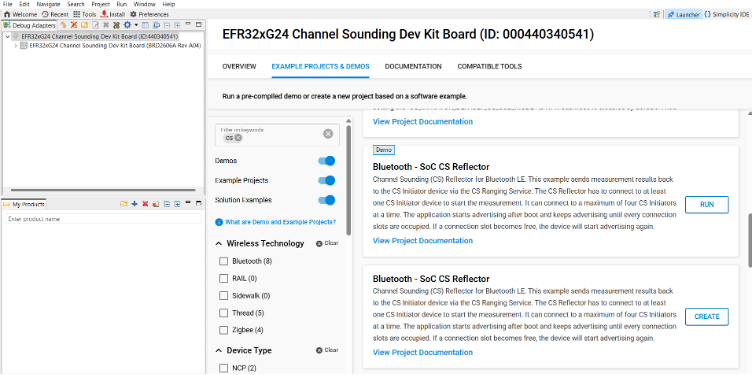
Connect a BRD2606A board to the PC/Laptop and open Simplicity Studio. Locate and create the Bluetooth – SoC CS Reflector example project. Before proceeding, follow the configuration steps in the README file included with the project. Once the configuration is complete, build the project.
Erase the board and flash the Bluetooth – SoC CS Reflector firmware from Simplicity Studio onto the Channel Sounding Development Kit (BRD2606A board).
Simplicity Connect Mobile App Setup#
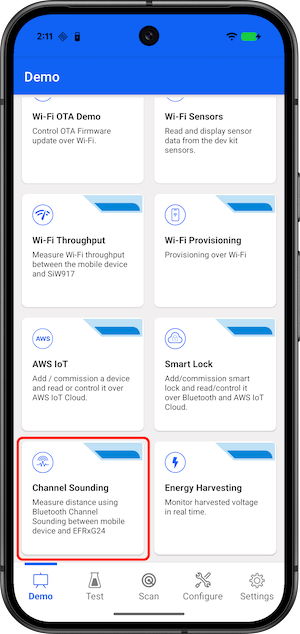
Open the Simplicity Connect mobile app on your smartphone, then tap the Demo icon in the navigation bar. Locate the “Channel Sounding” demo tile and tap it to start the demo.
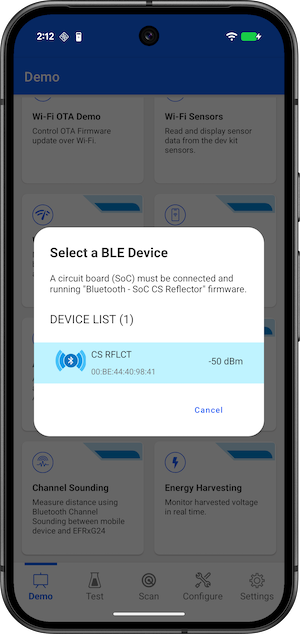
When the demo starts, a device selection window appears, allowing you to choose the device you want to connect to.
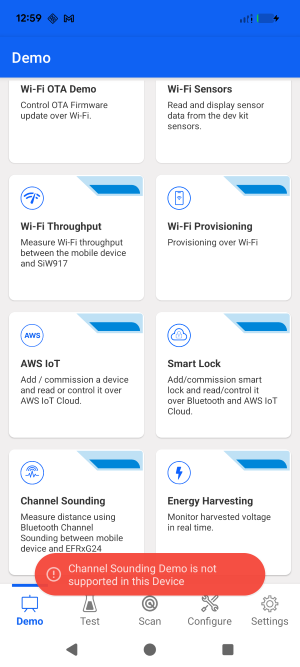
Note: If the smartphone (CS Initiator) does not support the Channel Sounding feature, an alert will be displayed when the you tap on the “Channel Sounding” demo.
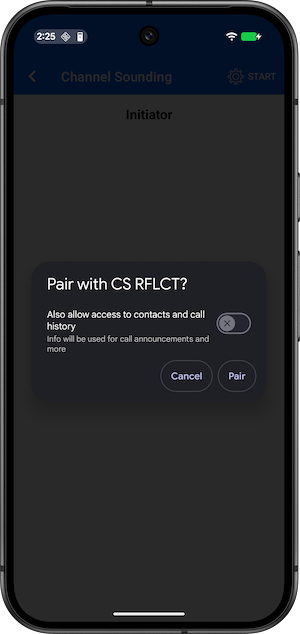
Once the smartphone (CS Initiator) is connected to the Channel Sounding Reflector (CS RFLCT) device, you are redirected to the Channel Sounding home screen and the Bluetooth pairing sequence begins. When the you tap the Pair button in the pairing popup, the CS Reflector is successfully paired and bonded.
Once the CS Reflector starts sending distance information to the CS Initiator (smartphone), the phone will compute the distance and display on the screen.
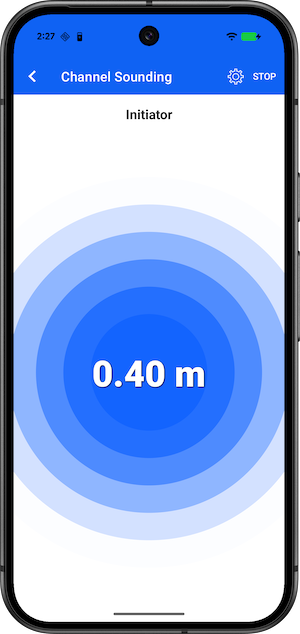
You can also Start/Stop the Channel Sounding operation on smartphones (CS Initiator) by pressing the Start/Stop button located on the top right corner of the app. You can change the configuration by pressing the setting icon present on the top right corner of the app. Below are the settings that can be changed.
Note: If the smartphone (CS Initiator) has already saved the Channel Sounding Reflector in the connected devices section, the app will prompt you with an alert message to remove it from the device settings.
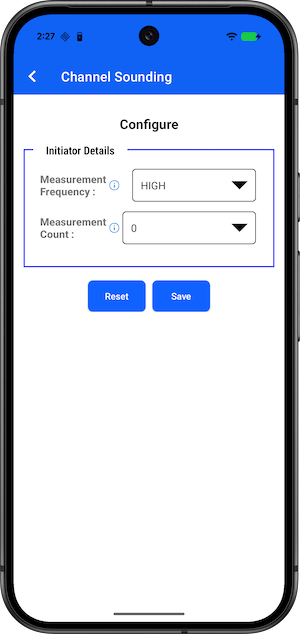
From the Configuration screen, you can change the following configurations:
Measure Frequency: Select the signal frequency range of BT Spectrum for channel sounding. The default option is "High".
Measurement Count: Specify the number of measurements to collect during sounding. The default option is “0”.
Clicking on the Reset button will restore the configuration to its default. After you select the required fields and click the Save button, the configuration is successfully saved. This configuration will continue to be used until you change it again.
Kalman Filter#
The Channel Sounding demo includes a Kalman filter that smooths raw BLE distance measurements for improved accuracy and stability. The filter is always active and processes every high-confidence measurement through a multi-stage pipeline.
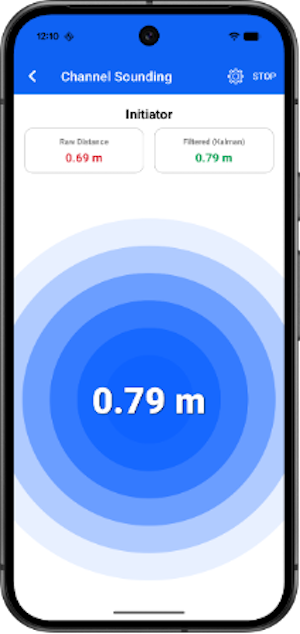
The measurement screen displays both values side by side:
Raw Distance (red) — the unprocessed distance reported by the BLE Channel Sounding API.
Filtered (green) — Filtered smooth estimate distance using Kalman Filter.
Configuring the Kalman Filter#
To access filter settings, tap the settings icon (gear) in the top-right corner of the measurement screen. The Configuration screen now includes a Kalman Filter section below the existing Measurement Frequency and Measurement Count settings.
Filtering Level#
The Filtering Level dropdown lets you choose how aggressively the Kalman filter smooths the distance measurements. Available options are given in the table below
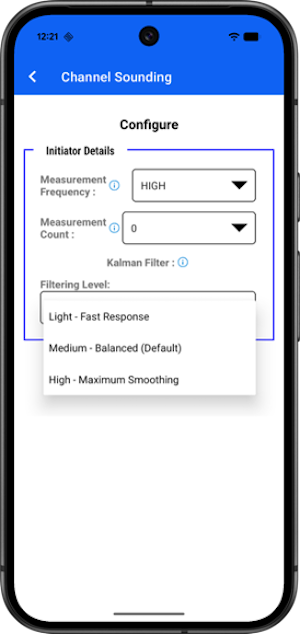
| Level | Description | Behavior | When to Use |
|---|---|---|---|
| Light - Fast Response | Minimal smoothing, fastest reaction to distance changes. Best for dynamic scenarios where quick tracking is needed. | Lower latency, more noise visible. | When you need the filtered distance to track rapid movements closely. |
| Medium - Balanced (Default) | Balanced trade-off between smoothing and responsiveness. Recommended for most use cases. | Moderate latency, good stability | Provides a good balance between measurement stability and response time. |
| High - Maximum Smoothing | Maximum noise reduction with aggressive outlier rejection. Best for stationary or slow-moving scenarios where stability is critical. | Higher latency, smoothest output. | To get most stable distance readings. |
Saving and Resetting Configuration#
Tap Save to apply and persist your selected filtering level. The configuration is retained across app sessions.
Tap Reset to restore all settings (including the filtering level) to their defaults (Medium - Balanced).
The Kalman filter includes built-in adaptive outlier rejection. When a raw measurement deviates significantly from the current estimate (based on an innovation-sigma gate), the filter automatically reduces its trust in that measurement instead of discarding it entirely. This prevents sudden spikes from corrupting the filtered output while still allowing gradual distance changes to be tracked.
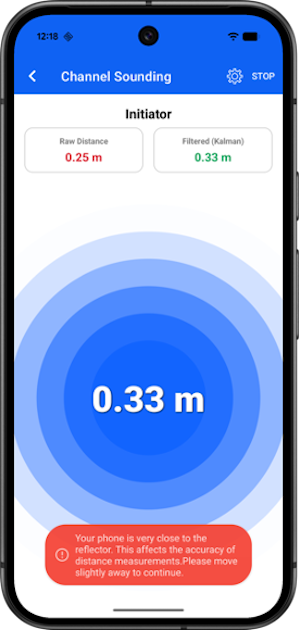
Note: When the smartphone (CS Initiator) is very close to the Channel Sounding Reflector, a red warning banner appears at the bottom of the screen:
"Your phone is very close to the reflector. This affects the accuracy of distance measurements. Please move slightly away to continue."
Troubleshooting#
| Level | Description |
|---|---|
| Filtered distance seems slow to react | Switch to Light - Fast Response filtering level in the Configuration screen. |
| Distance readings are jumpy/noisy | Switch to High - Maximum Smoothing filtering level for more aggressive smoothing. |
| Proximity warning appears | Move the smartphone farther from the reflector. Measurements below ~0.2 m may be unreliable. |
| Raw and Filtered values differ significantly | This is expected — the filter is smoothing out noise and rejecting outlier measurements. The Filtered (Kalman) value is the recommended reading. |