


Z-Wave Battery Support Basics#
NOTE: This section replaces APL12957: Z-Wave Battery Support Basics. Further updates to this application note will be provided here.
Easy-reading introduction to Device Type and Command Class specification text on battery support. This application note covers WakeUp and FLiRS beaming functionality.
Z-Wave enables a variety of monitoring and control applications. Sensors can send data to a gateway or control actuators directly based on certain criteria. Input devices like remote controls or wall controllers may report button presses to a scene controller or control actuators directly.
Battery operation necessitates strict control of the power consumption. Ideally, a battery powered node should be in power down state at any time. In power down state, the processor and memory system is powered down. Before powering down, the application makes sure to configure hardware peripherals to a state of minimum power consumption.
A node in permanent power down state is called a Sleeping node.
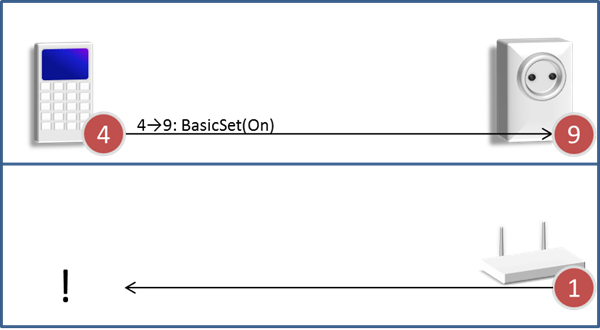
The example below shows a sleeping node implementing a remote control. The remote control only wakes up in response to a button press. Other nodes cannot send commands to a sleeping node as it returns to the power down state immediately after completing its task.
Reporting Sleeping Node (RSS)#
It may be useful to send commands to a battery powered node, for instance to change configuration parameters. A Reporting Sleeping node wakes up periodically to contact another node, e.g. a gateway and/or to send commands directly to other nodes in the network.
In this example, a Reporting Sleeping node implements a temperature sensor. The node wakes up to make temperature measurements and report the readings to a display device. At more rare events, e.g. every 70 minutes, the node also sends a WakeUp Notification to a gateway.
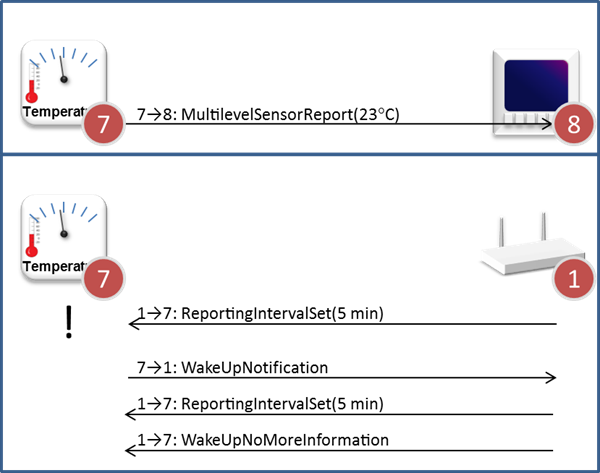
By only waking up a few times every hour to report a measurement, the RSS may remain in power down state most of the time while being able to receive commands from other nodes in relation to the WakeUp Notification. The gateway may try an immediate transmission to the Sleeping node, hoping that the node is already awake, but it can only be sure of reaching the Sleeping node after receiving a WakeUp Notification.
A gateway based control system will often monitor the system in order to detect defunct nodes. Always listening nodes may be polled at low frequency. WakeUp Notifications from a RSS can be used to achieve a similar monitoring of the health of Sleeping nodes.
Listening Sleeping Node (LSS)#
A Listening Sleeping node uses a special radio transmission method called beaming. This allows other nodes to deliver a command to the LSS within one second.
The following example shows how a FLiRS node may be used to implement a remote controlled door lock.
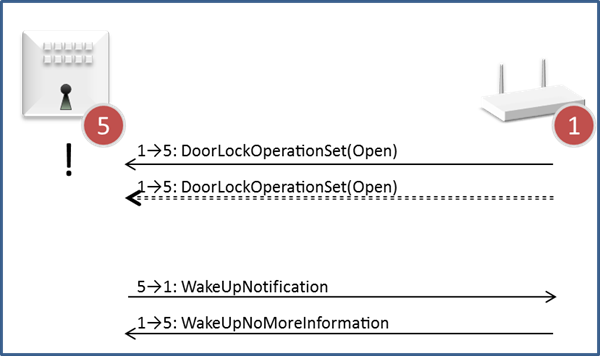
Beaming is slower than other transmission methods and it is power consuming. Further, beaming causes a short interruption to other nodes in the network. The gateway may try an immediate transmission to the LSS node, hoping that the node is already awake, before using beaming to deliver the command.
A gateway based control system will often monitor the system in order to detect defunct nodes. Always listening nodes may be polled at low frequency. WakeUp Notifications can be used to achieve a similar monitoring of the health of LSS nodes; thus avoiding beaming when there is no actual need for quick delivery of a command.
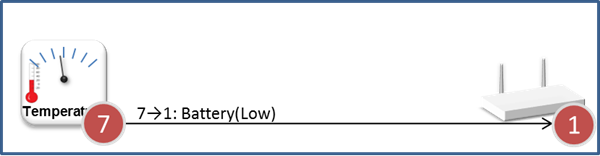
A battery powered node monitors its battery and issues a warning when reaching a critical level.
Battery Monitoring#
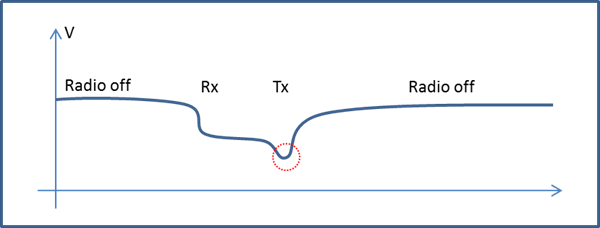
Due to the chemistry of batteries, the voltage tends to be higher when there is no significant load on the battery. Therefore, a battery operated node monitors the battery during periods where the load is highest; typically while transmitting.
More Information#
More information about the Role Types in Z-Wave and the WakeUp Command Class can be found in the latest documentation package from the Z-Wave Alliance.