


Production Provisioning Principles#
This page explains how device credentials move from factory provisioning to the Amazon Sidewalk cloud. It introduces the Amazon production flow and the Silicon Labs additions. The following pages describe Secure Vault integration, on-device certificate generation, and registration over wire.
Amazon production flow#
Amazon's manufacturing process covers the factory setup, provisioning of each endpoint, upload of control logs, and creation of device records in the AWS account. See the Amazon manufacturing documentation for the full process and tools, and the AWS bulk provisioning guide for cloud-side device creation.
The Silicon Labs steps in this section fit into the factory provisioning phase; the other Amazon steps remain the same.
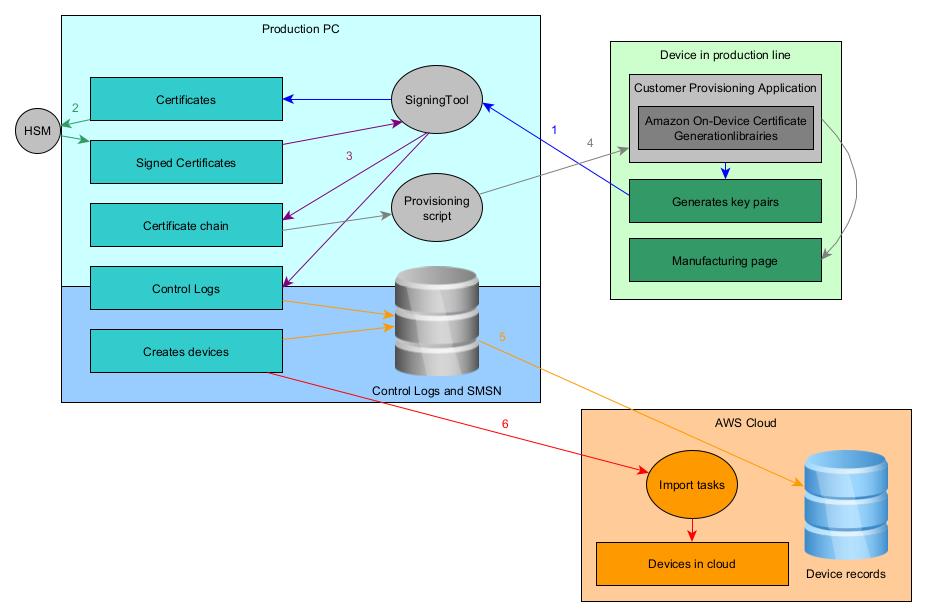
In the standard flow, each endpoint receives unique credentials and a Sidewalk Manufacturing Serial Number (SMSN). The factory tools produce the public certificate information and control logs used to register the device in AWS. In workflows where cloud upload is deferred, control logs can be transferred to a separate connected computer, allowing the provisioning workstation to remain offline. ROW changes this requirement: its Amazon tool creates the cloud record and completes registration, so the factory computer must be online while it runs.
Silicon Labs production flow#
Silicon Labs provides the Production Device Provisioner (PDP) application for communicating with an EFR32 device during provisioning. In the usual flow, PDP runs from RAM and is removed when the device reboots. The ROW-enabled PDP includes additional code and must instead be temporarily flashed to device flash; after provisioning and registration, erase it and flash the product application. See Registration Over Wire.
The scripts are in tools/scripts/public/pdp in the Amazon Sidewalk extension. For production, the recommended certificate flow generates private keys on the device. The host sends public requests for signing and writes returned certificate chains and other required public data to the device. The private keys remain on the device.
The usual production provisioning flow has two main phases:
Prepare the shared image. Build or select the product application image. For on-device certificate generation, a separate initialization image is generally not required; consult the script options for the SDK version in use.
Provision each unit. The PDP and host script generate the device identity, obtain certificates through the Amazon signing process, and store device-specific provisioning data.
The resulting public records and control logs are then handled through Amazon's standard cloud-side manufacturing process.
Provisioning approaches#
Approach | Key creation | Intended use | Notes |
|---|---|---|---|
On-device certificate generation | On the device | Production | Private keys stay on the device; signing is performed using Amazon's provisioned signing infrastructure. See On-Device Certificate Generation. |
Cloud-generated prototype credentials with Secure Vault | In the cloud, then provisioned to the device | Development and Secure Vault evaluation | Use only for prototypes. See Provision a prototyping device with Secure Vault. |
The legacy OpenSSL private-key provisioning flow has been removed from this guide. Amazon Sidewalk SDK 1.16 and later requires on-device certificate generation for new production products and new YubiHSM provisioning requests; confirm current requirements with Amazon for an existing product.
Where Secure Vault fits#
On supported Silicon Labs hardware, Secure Vault protects Sidewalk private keys. For the hardware and application configuration, see Secure Vault Integration. The production certificate-generation procedure is in On-Device Certificate Generation.
Registration after provisioning#
Provisioning installs the device credentials, while registration is the subsequent process of joining the Sidewalk network. The factory can use ROW to perform or support registration through a wired host connection. For more information about the workflow and its relationship to production provisioning, see Registration Over Wire.
Sample applications provide two software components for registration: Sidewalk factory registered and Sidewalk on-air registration. Sidewalk on-air registration is included by default. When a device is registered at the factory, you can replace it with Sidewalk factory registered to remove the on-air registration code and reduce the application footprint. Currently, Sidewalk factory registered is available only for BLE-only applications.