


Add a New Series 2 Device to the Programmer#
The programmer in this application note uses EFR32MG22C224F512IM40 as a host controller. The defines in the following table for EFR32MG22C224F512 should usually apply to the new Series 2 devices.
Defines for EFR32MG22C224F512
Item | Define | Value |
|---|---|---|
Main flash base address | FLASH_MEM_BASE in efr32mg22c224f512im40.h | 0x00000000 |
User data base address | USERDATA_BASE in efr32mg22c224f512im40.h | 0x0FE00000 |
MSC base address | MSC_BASE in efr32mg22c224f512im40.h | 0x40030000 |
Offset and bitfields of MSC registers | MSC Register Map in xG22 reference manual | — |
DEVINFO base address | DEVINFO_BASE in efr32mg22c224f512im40.h | 0x0FE08000 |
Offset and bitfields of DEVINFO registers | DEVINFO Register Map in xG22 reference manual | — |
CMU base address | CMU_BASE in efr32mg22c224f512im40.h | 0x40008000 |
Offset of CMU_CLKEN1_SET register | CMU Register Map in xG22 reference manual | 0x00001068 |
Bitmask to enable MSC clock | CMU_CLKEN1_MSC in efr32mg22_cmu.h | 0x00020000 |
AP IDR (Cortex-M33) | S2_AHBAP_ID in app_dci_swd.h | 0x84770001 |
TAR wrap mask (Cortex-M33) | TAR_WRAP_1K in app_swd_task.h | 0x3FF |
Users need to define new items if any defines in the table above do not match the new Series 2 device. And users may require tuning the settings in Compile Options for the new Series 2 device.
The following procedures describe how to add the xG23 device to the programmer.
Add
XG23_FAMILY(0x17for 23) toapp_swd_task.h.It is0x15for xG21,0x16for xG22,0x17for xG23, etc./// Device family of xG23 #define XG23_FAMILY (0x00170000UL)The items below are different from the EFR32MG22C224F512 after checking the xG23 header files (e.g., efr32fg23b010f512im48.h) and reference manual.
Main flash base address — Add
FLASH_BASE_XG23toapp_swd_task.h.
/// Flash start address of xG23 #define FLASH_BASE_XG23 (0x08000000UL)Bitmask to enable MSC clock — Add
CLKEN1_MSC_XG23toapp_swd_task.h.
/// MSC bit of xG23 CMU_CLKEN1_SET #define CLKEN1_MSC_XG23 (0x00010000UL)Add code to
app_swd_task.cto enable MSC clock and set flash base address.// Enable MSC clock if device is xG23 if (buf0 == XG23_FAMILY) { write_mem((uint32_t)&(CMU->CLKEN1_SET), CLKEN1_MSC_XG23); // Check UDLOCKBIT on xG23 if (read_mem((uint32_t)&(MSC->MISCLOCKWORD)) & MSC_MISCLOCKWORD_UDLOCKBIT) { RAISE(SWD_ERROR_USERDATA_LOCK); } // Flash start address for xG23 flash_start_addr = FLASH_BASE_XG23; }Add
DEVICE_XG23(ASCII code of character "3") toapp_process.h.It is "1" for xG21, "2" for xG22, "3" for xG23, etc./// xG23 device #define DEVICE_XG23 (0x33)The hse_svm_conf[] can apply to xG23A (HSE-SVM) devices. Add ||
defined(DEVICE_XG23)tohse_svm_conf[]inapp_dci_ta sk.c.#if defined(DEVICE_XG21) || defined(DEVICE_XG23) /// HSE-SVM user configuration static const uint32_t hse_svm_conf[HSE_USER_CONF_SIZE] = { 0x00000018, // 24 bytes data below SECURE_BOOT_ENABLE_MASK + ANTI_ROLLBACK_MASK, // MCU settings 0x00000000, // 20 bytes reserved data 0x00000000, 0x00000000, 0x00000000, 0x00000000 }; #endifThe hse_svh_xg21b_conf[] cannot apply to xG23B (HSE-SVH) devices. Add hse_svh_other_conf[] to
app_dci_task.c.#if defined(DEVICE_XG23) /// Other HSE-SVH user configuration static const uint32_t hse_svh_other_conf[HSE_USER_CONF_SIZE] = { 0x00000018, // 24 bytes data below SECURE_BOOT_ENABLE_MASK + ANTI_ROLLBACK_MASK, // MCU settings 0x40440410, // Tamper settings 0x14040104, 0x22414224, 0x74422112, 0x0500060A }; #endifAdd code (based on
case DEVICE_XG21:, replacehse_svh_xg21b_confwithhse_svh_other_conf) toapp_dci_task.cto set up a command buffer for OTP configuration.#if defined(DEVICE_XG23) case DEVICE_XG23: // Check SVM or SVH if (*(cmd_buf + 2) == 'A') { *cmd_buf = INIT_HSE_OTP_LENGTH; *(++cmd_buf) = COMMAND_INIT_OTP; // Calculate parity of OTP configuration *(++cmd_buf) = 0; for (i = 1; i < HSE_USER_CONF_SIZE; i++) { *cmd_buf ^= hse_svm_conf[i]; } // Copy OTP configuration to buffer memcpy((uint32_t *)(++cmd_buf), (uint32_t *)hse_svm_conf, INIT_HSE_OTP_LENGTH); } else if (*(cmd_buf + 2) == 'B') { *cmd_buf = INIT_HSE_OTP_LENGTH; *(++cmd_buf) = COMMAND_INIT_OTP; // Calculate parity of OTP configuration *(++cmd_buf) = 0; for (i = 1; i < HSE_USER_CONF_SIZE; i++) { *cmd_buf ^= hse_svh_other_conf[i]; } // Copy OTP configuration to buffer memcpy((uint32_t *)(++cmd_buf), (uint32_t *)hse_svh_other_conf, INIT_HSE_OTP_LENGTH); } else { RAISE(SWD_ERROR_UNKNOWN_DEVICE); } break; #endifAdd firmware images to
app_firmware_image.candapp_firmware_image.h.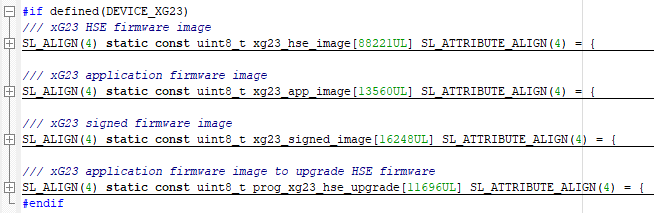
Add functions to
app_firmware_image.candapp_firmware_image.hto get the address and size of firmware images.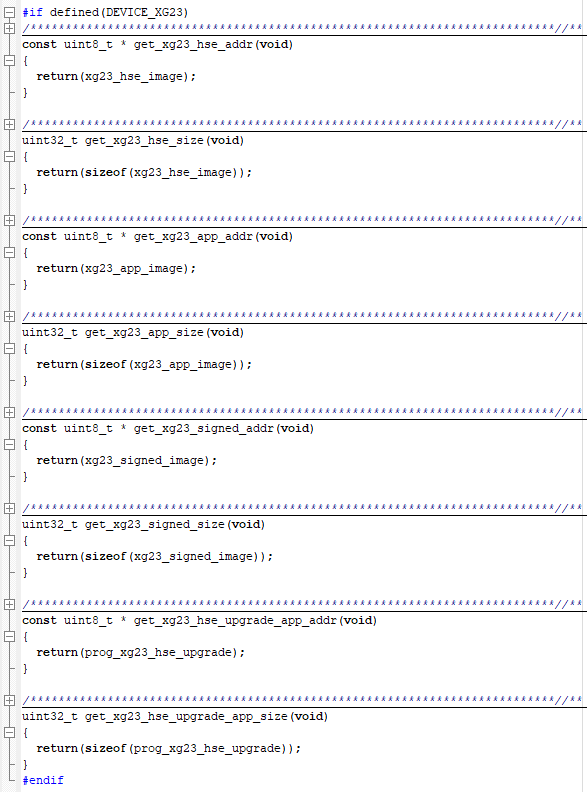
The
tamper_source_xg21b[]cannot be applied to xG23B (HSE-SVH) devices. Addtamper_source_other[]toapp_process.c.#if defined(DEVICE_XG23) /// Strings for tamper sources of other HSE-SVH devices static const char *tamper_source_other[TAMPER_SIGNAL_NUM] = { NULL, "Filter counter : ", "SE watchdog : ", NULL, "SE RAM ECC 2 : ", "SE hard fault : ", NULL, "SE software assertion : ", "SE secure boot : ", "User secure boot : ", "Mailbox authorization : ", "DCI authorization : ", "OTP Read : ", NULL, "Self test : ", "TRNG monitor : ", "Secure lock : ", "Digital glitch : ", "Voltage glitch : ", "SE ICACHE : ", "SE RAM ECC 1 : ", "BOD : ", "Temperature sensor : ", "DPLL lock fail low : ", "DPLL lock fail high : ", "PRS0 : ", "PRS1 : ", "PRS2 : ", "PRS3 : ", "PRS4 : ", "PRS5 : ", "PRS6 : " }; #endifAdd ||
defined(DEVICE_XG23)and code (based oncase DEVICE_XG21:, replacetamper_source_xg21bwithtamper_source_other) to functionprint_otp_conf()inapp_process.cto print out the tamper configuration.#if defined(DEVICE_XG21) || defined(DEVICE_XG23) uint32_t i; uint32_t j; uint32_t k; #endif ... #if defined(DEVICE_XG23) case DEVICE_XG23: for (i = 0, j = 0, k = 2; i < TAMPER_SIGNAL_NUM; i++, j += 4) { if (j == 32) { j = 0; k++; } cmd_resp_buf[8] = (cmd_resp_buf[k] >> j) & 0x0f; if (tamper_source_other[i] != NULL) { printf(" %s %lu\n", tamper_source_other[i], cmd_resp_buf[8]); } } break; #endif ... #if defined(DEVICE_XG21) || defined(DEVICE_XG23) // Common tamper parameters printf(" + Reset period for the tamper filter counter: ~32 ms x %u\n", 1 << (cmd_resp_buf[6] & COUNTER_PERIOD_MASK)); printf(" + Activation threshold for the tamper filter: %d\n", 256 / (1 << ((cmd_resp_buf[6] & COUNTER_THRESHOLD_MASK) >> COUNTER_THRESHOLD_SHIFT))); if (cmd_resp_buf[6] & GLITCH_DETECTOR_MASK) { printf(" + Digital glitch detector always on: Enabled\n"); } else { printf(" + Digital glitch detector always on: Disabled\n"); } if (device_name[DEVICE_INDEX] > DEVICE_XG22) { if (cmd_resp_buf[6] & SLEEP_ALIVE_MASK) { printf(" + Keep tamper alive during sleep: Enabled\n"); } else { printf(" + Keep tamper alive during sleep: Disabled\n"); } } printf(" + Tamper reset threshold: %lu\n", cmd_resp_buf[6] >> TAMPER_RESET_SHIFT); #endifAdd code (take
case DEVICE_XG21:as reference) to functionprog_main_flash_app()inapp_process.c.#if defined(DEVICE_XG23) case DEVICE_XG23: printf(" + The xG23 application firmware image size is %lu bytes " "and start address is 0x%08lX.\n", get_xg23_app_size(), get_flash_start_addr()); printf(" + Erase-Program-Verify the xG23 main flash for " "application firmware image... "); cmd_resp_buf[0] = prog_flash(get_flash_start_addr(), get_xg23_app_size(), (uint32_t *)get_xg23_app_addr()); print_cycle_time(); break; #endifAdd code (take
case DEVICE_XG21:as reference) to functionprog_main_flash_se()inapp_process.c.#if defined(DEVICE_XG23) case DEVICE_XG23: printf(" + The xG23 HSE firmware image version: %08lX\n", *((uint32_t *)get_xg23_hse_addr() + 3)); printf(" + The xG23 HSE firmware image size is %lu bytes and start " "address is 0x%08lX.\n", get_xg23_hse_size(), SE_START_ADDR + get_flash_start_addr()); printf(" + Erase-Program-Verify the xG23 main flash for HSE " "firmware image... "); cmd_resp_buf[0] = prog_flash(SE_START_ADDR + get_flash_start_addr(), get_xg23_hse_size(), (uint32_t *)get_xg23_hse_addr()); print_cycle_time(); break; #endifAdd code (take
case DEVICE_XG21:as reference) to functionprog_main_flash_se_app()inapp_process.c.#if defined(DEVICE_XG23) case DEVICE_XG23: printf(" + The xG23 HSE upgrade application firmware image size is " "%lu bytes and start address is 0x%08lX.\n", get_xg23_hse_upgrade_app_size(), get_flash_start_addr()); printf(" + Erase-Program-Verify the xG23 main flash for " "application to upgrade \n"); printf(" HSE firmware... "); cmd_resp_buf[0] = prog_flash(get_flash_start_addr(), get_xg23_hse_upgrade_app_size(), (uint32_t *)get_xg23_hse_upgrade_app_addr()); print_cycle_time(); break; #endifAdd code (take
case DEVICE_XG21:as reference) to functionprog_main_flash_signed()inapp_process.c.#if defined(DEVICE_XG23) case DEVICE_XG23: printf(" + The xG23 signed firmware image size is %lu bytes " "and start address is 0x%08lX.\n", get_xg23_signed_size(), get_flash_start_addr()); printf(" + Erase-Program-Verify the xG23 main flash for " "signed firmware image... "); cmd_resp_buf[0] = prog_flash(get_flash_start_addr(), get_xg23_signed_size(), (uint32_t *)get_xg23_signed_addr()); print_cycle_time(); break; #endifFor xG23 devices, the user data can be erased the same way as any page in the main flash. Add code (take
case DEVICE_XG22:as reference) to functionerase_user_data()inapp_process.c.#if defined(DEVICE_XG23) case DEVICE_XG23: printf("\n . Erase xG23 user data... "); cmd_resp_buf[0] = erase_flash(true); print_cycle_time(); hard_reset_target(); break; #endifFor xG23 devices, the user data can be written the same way as any page in the main flash. Add code (take
case DEVICE_XG22:as reference) to functionprog_user_data()inapp_process.c.#if defined(DEVICE_XG23) case DEVICE_XG23: printf("\n . Program xG23 user data.\n"); printf(" + User data size is %lu bytes and start address is 0x%08lX.\n", get_userdata_size(), USERDATA_BASE); printf(" + Erase-Program-Verify the xG23 user data... "); cmd_resp_buf[0] = prog_flash(USERDATA_BASE, get_userdata_size(), (uint32_t *)get_userdata_addr()); print_cycle_time(); hard_reset_target(); break; #endifThere is no need to change the default settings in Compile Options for xG23 devices.
Note: The 512 kB flash of EFR32MG22C224F512 is not enough to store the firmware images when the programmer needs to support more Series 2 devices. Users can selectively comment out the defines in
app_process.hto save memory for the required Series 2 devices./// xG21 device #define DEVICE_XG21 (0x31) /// xG22 device define DEVICE_XG22 (0x32) /// xG23 device #define DEVICE_XG23 (0x33)