


Test Network and Conditions#
For Remote Provisioning performance testing, Silicon Labs built an RF-shielded environment to filter out the ongoing interference in the office area.
Large network testing is best conducted in an open-air environment for multiple reasons. The existing and varying RF conditions make this environment closer to a real-life scenario. However, the tests were conducted in the evening of workdays, and on the weekend, to eliminate some of the noise created by the human work in the office. The Silicon Labs Budapest office was used for this open-air testing.
Office and Test Network Conditions#
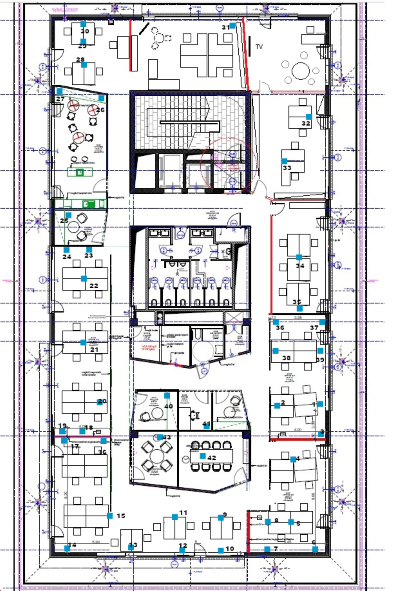
The multicast latency and the OTA DFU tests were carried out on the large network test setup located in the office. A total of 43 boxes were scattered around the floor, each containing 4-6 devices to create a 256-node network on a large area with naturally occurring hops in the network.
Each box contained six Silicon Labs Wireless Starter Kits (WSTKs), except one, which contained four WSTKs. The first 27 boxes had four BRD4186C (EFR32xG24) and two BRD4181B (EFR32xG21) radio boards each. Boxes 28-42 had three BRD4186C and three BRD4181B radio boards. Box 43 had four BRD4186C radio boards and one BRD4181B radio board.
The office is rectangular in shape, with sides of 38m and 19m. There is an 18.5m by 7.5m area where devices were not placed because of stairs, elevators, bathrooms, and different maintenance rooms.
Wireless Conditions in the Office#
There were multiple test setups located on the floor, with hundreds of devices using BLE protocol. In the office, there were also four different Wi-Fi networks accessible on 2.4 GHz. The following chart was taken as a snapshot of a normal workday Wi-Fi scan. This is considered the normal Wi-Fi background traffic.
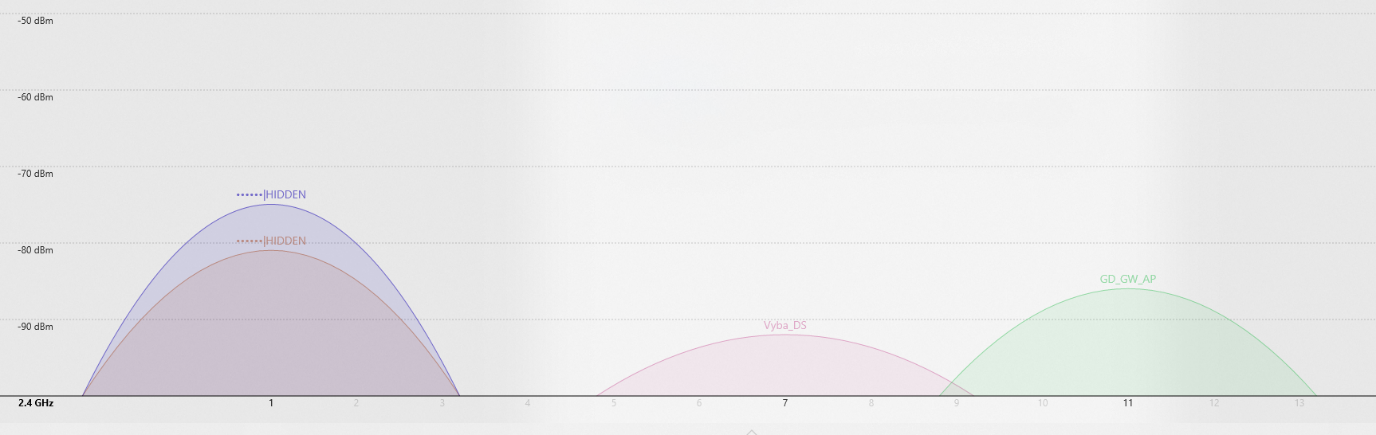
Running the tests on the evenings and weekends eliminated a large part of this noise, while maintaining real-life scenarios.
Multi-Hop Test Network#
For the Remote Provisioning performance and multi-hop latency, tests were carried out in an RF-shielded multi-hop test network. Eight RF isolation boxes were chained together via SMA and attenuation barrels, and each of these boxes contained at least one BRD4187C (EFR32xG24) radio board, which were used for the BT Mesh test cases. This setup ensured that no RF interference affected the testing, minimizing variability, while also creating six hops in the network.