


Example Tests and Results from Silicon Labs#
This section provides the test results that were achieved using the setup described previously.
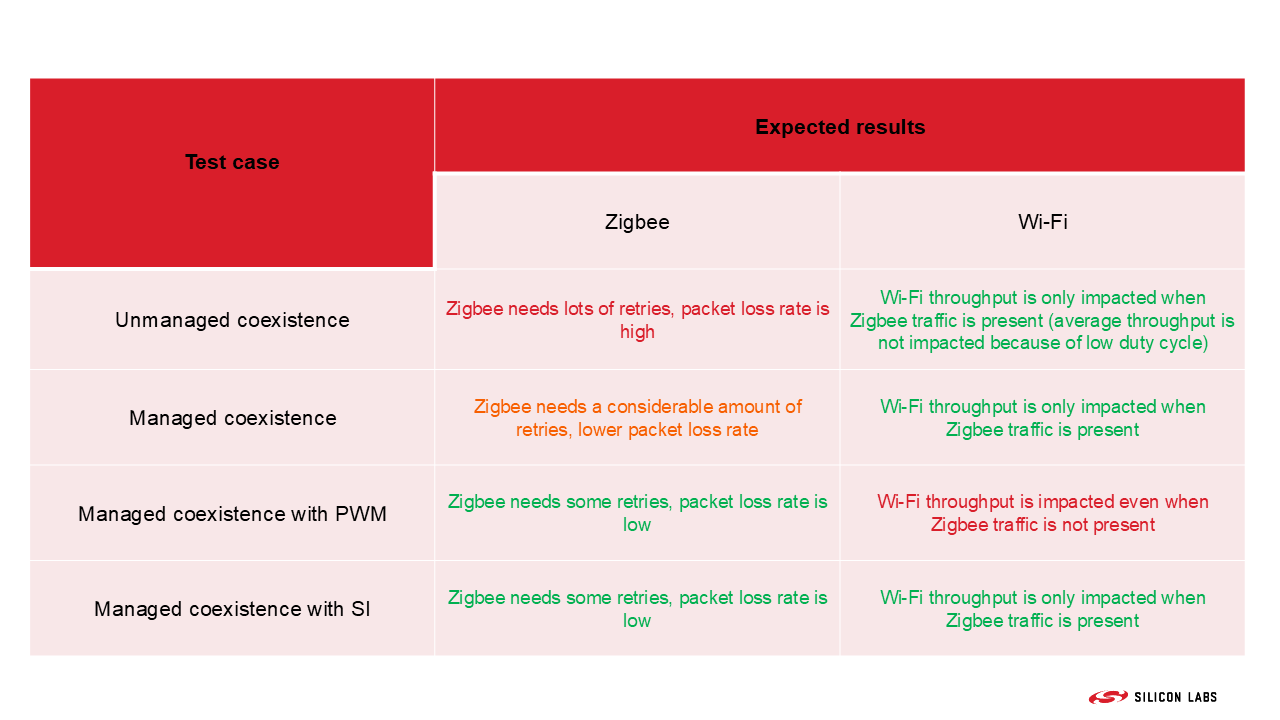
Based on the configurations used, the expected results can be seen in the picture below. These expectations are based on existing knowledge about how a coexistence scenario should play out, and how the different solutions should affect them.
Results#
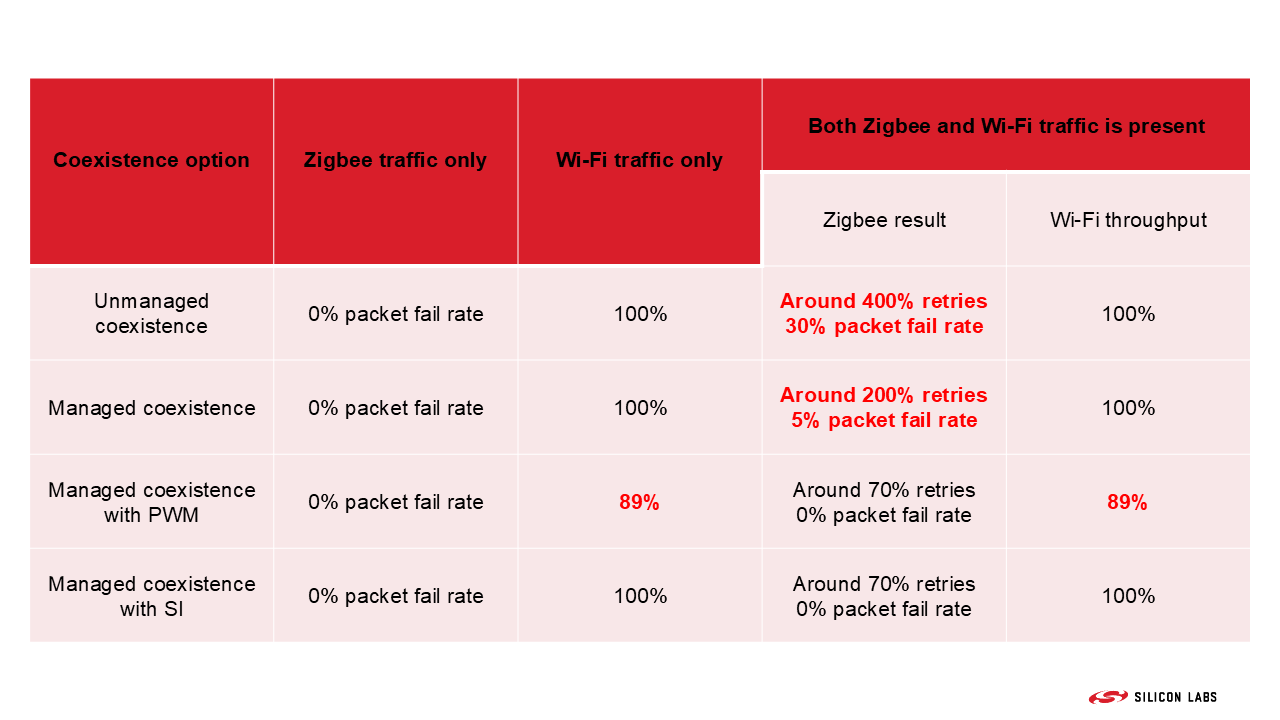
The results of the testing efforts can be seen in the picture below. It can generally be said that the results match expectations quite well. As stated previously, these system level tests depend on a lot of variables, and the results are somewhat random in nature, as performance depends on the relative timings of different communication events, so these numbers are not 100% exact. Also, since these numbers have been measured in a single setup, they are most likely not directly relevant to any real world use case.
However, the general behavior seen is extremely relevant for all coexistence devices. As shown below, unmanaged coexistence comes with a high price from the Zigbee device: a high rate of application level packet fails with a huge amount of extra retries on the MAC level. In a real world scenario, these numbers would result in an unreliable Zigbee network with higher than normal current consumption for end nodes.
This can be eliminated using managed coexistence. For good RX performance, the PWM feature can be used. The main drawback is that it restricts Wi-Fi throughput even when no Zigbee traffic is present.
In this test configuration, enabling PWM reduced Wi-Fi throughput by approximately 10%. With the PWM setting enabled, application-layer packet failures were reduced to 0%. This resulted in a reliable Zigbee connection, with no loss of critical data or commands between devices.
As shown in the results below, the Signal Identifier feature can help maintain good Zigbee performance while preserving Wi-Fi throughput, provided the device uses a Silicon Labs chip that supports this feature. In this configuration, Wi-Fi throughput is affected only when Zigbee traffic is present, which typically corresponds to a very low duty cycle.
For these tests, a Zigbee packet was transmitted every 5 seconds. As a result, the impact on Wi-Fi throughput is not noticeable in the final results.
These results suggest that, if the design allows the Wi-Fi device's PA Enabled signal to be routed to an EFR GPIO, the GPIO-based Signal Identifier is a valuable addition to the standard PTA functionality. If the PA Enabled signal is not available, the AGC-based Signal Identifier can be used instead.
Note: It is important to mention that both Signal Identifier trigger (AGC or GPIO based SI) resulted in similar performance numbers in these measurements.
Conclusion#
Based on the results of this system-level testing, coexistence is an important consideration when designing devices that incorporate both low-power, low-duty-cycle IoT protocols and Wi-Fi. Without an effective coexistence solution, the reception rates of the IoT protocol may be unacceptable for a given wireless application.
The PTA solutions and coexistence features offered by Silicon Labs help mitigate this issue while minimizing the impact on Wi-Fi throughput.