


Power Manager Configuration#
Integration Components#
Power Manager Component Variants
Power Manager: Deepsleep: Full power management with EM0-EM4 support
Power Manager: Deepsleep with blocking on HFXO restore: Removes the dependence on HFXO Manager and HFXO interrupt and improves power, but increases interrupt latency
Power Manager: No Deepsleep: EM2/EM3 removed for applications requiring constant peripheral availability
Note: SIXG301 must use "Power Manager: No Deepsleep" as it doesn't support EM2/EM3.
Configuration Files#
sl_power_manager_config.h#
Contains Power Manager specific settings for optimization and debugging:
// Enable custom IRQ handler for external HF oscillator
#define SL_POWER_MANAGER_CUSTOM_HF_OSCILLATOR_IRQ_HANDLER 0
// Enable or disable voltage scaling in EM2/3 modes (when available). This decreases wakeup time by about 30 us
// Deprecated. Replaced by sl_power_manager_em23_voltage_scaling_enable_fast_wakeup()
#define SL_POWER_MANAGER_CONFIG_VOLTAGE_SCALING_FAST_WAKEUP 0
// Enable voltage scaling in EM0 and EM1 mode
#define SL_POWER_MANAGER_ENABLE_EM01_VOLTAGE_SCALING 0
// Enable or disable debugging features (trace the different modules that have requirements)
#define SL_POWER_MANAGER_DEBUG 0
// Maximum number of requirements that can be logged
#define SL_POWER_MANAGER_DEBUG_POOL_SIZE 10
// Pin retention mode
#define SL_POWER_MANAGER_INIT_EMU_EM4_PIN_RETENTION_MODE EMU_EM4CTRL_EM4IORETMODE_DISABLE
// Enabling debug connectivity results in an increased power consumption in EM2/EM3
#define SL_POWER_MANAGER_INIT_EMU_EM2_DEBUG_ENABLE 1Universal Configurator Settings#
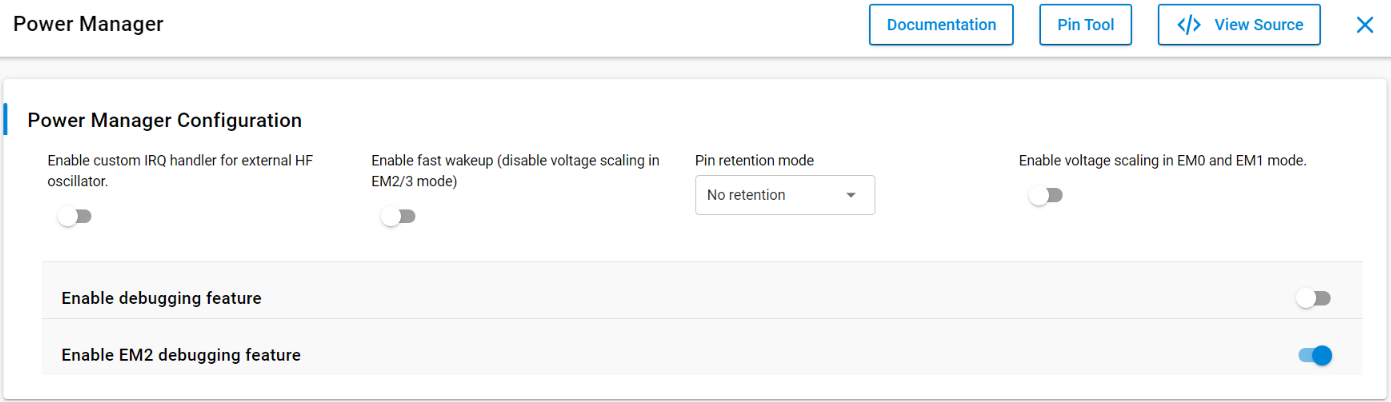
Key UC Parameters:
Voltage Scaling: Enable for maximum power efficiency
EM4 Pin Retention: Configure based on hardware requirements
Debug Features: Enable during development, disable for production