


Basic Green Power Network#
A basic Green Power (GP) network consists of three devices:
Green Power Device (GPD)
A Z3 Proxy or Green Power Proxy (GPP)
A Green Power Sink (GPS)
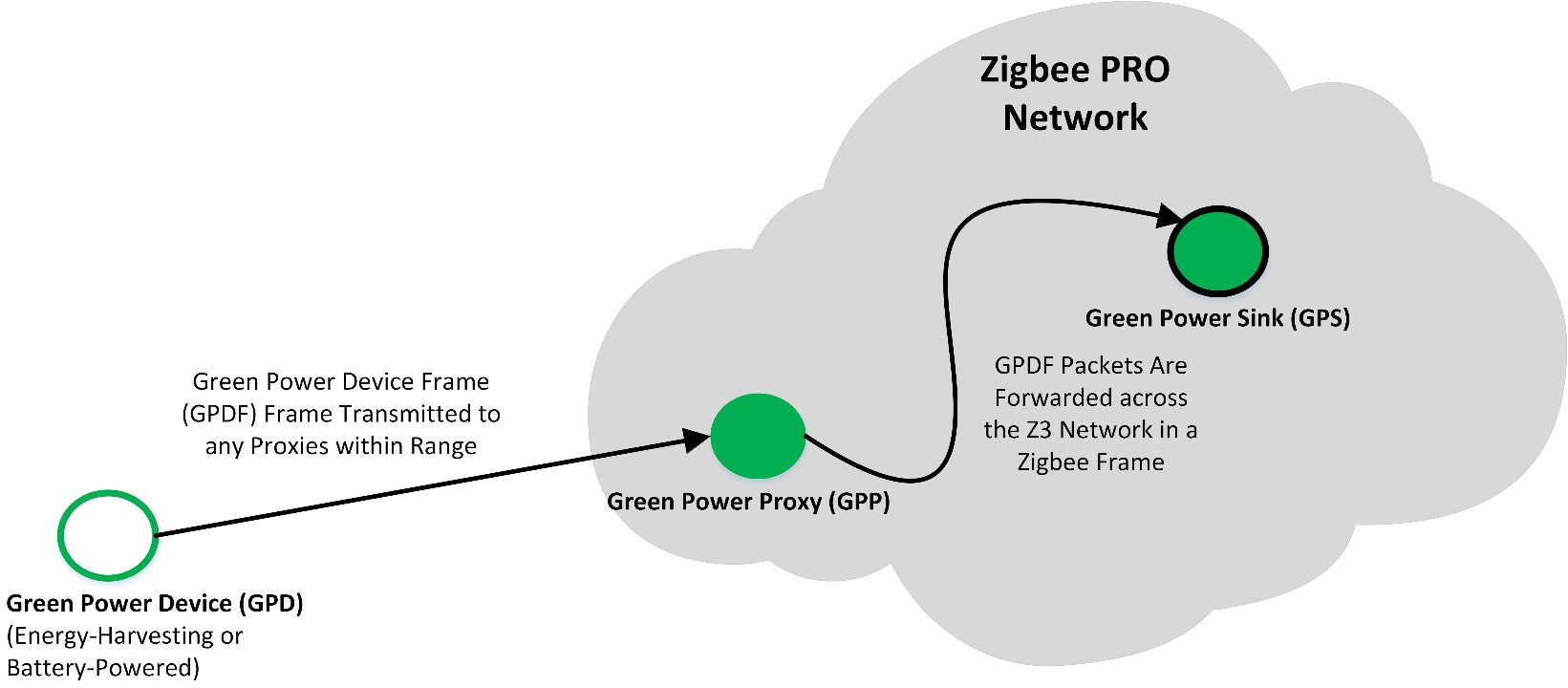
GPD Frames (GPDF) are transmitted by the GPD devices and received by a Proxy or a Combination (Sink and Proxy) device. The GPP will then encapsulate the received GPDF within a standard Zigbee frame and forward the GPDF packets across the Zigbee PRO / Z3 network in the form of notifications to the Sink that that has been paired with the end device. In a Combination device, the Proxy side is responsible for forwarding the GPDF packets. The following figure illustrates the data flow from the GPD to the GPP and finally to the GPS.
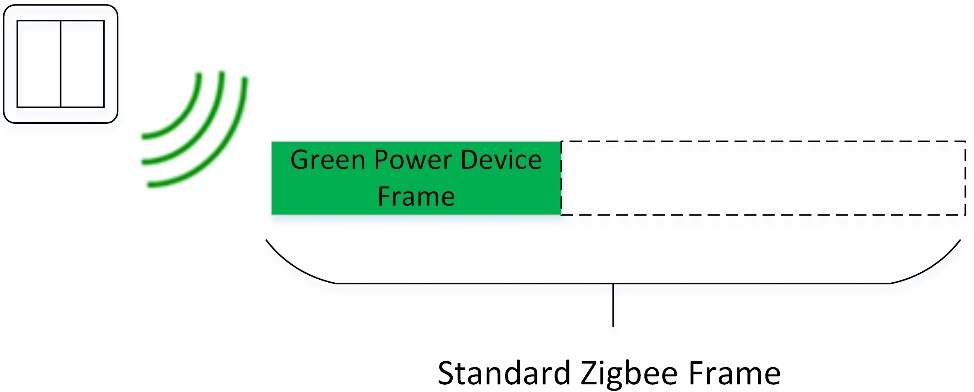
As indicated in the following figure, the GPDF is shorter than a standard Zigbee frame (indicated by the dashed line). This allows a GPD to transmit a GPDF using less power than a standard Zigbee frame as the radio transmitter is active for less time.
GPDs are primarily one-way devices once in use, although they may optionally (if designed) support bidirectional data exchange during pairing. GPDs should not be considered end devices and Zigbee considers them as less than Zigbee End Devices (ZEDs). For more information on ZEDs, see UG103.2: Zigbee Fundamentals.
How Does Green Power Fit in a Zigbee Network?#
The Zigbee stack architecture is illustrated in the following figure.
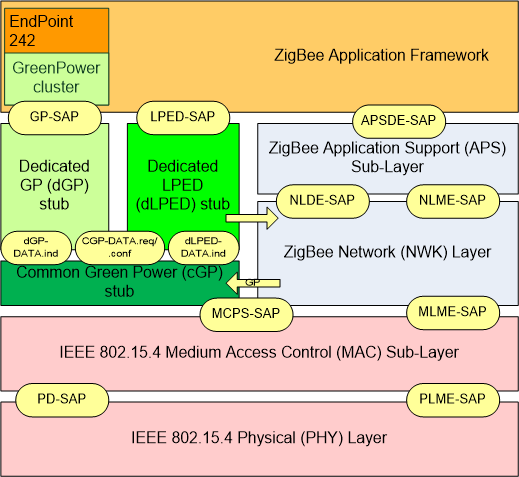
Green Power data exchanges are handled by a dedicated block or "stub" for the Zigbee Network (NWK) Layer and the Application Support Sub-layer (APS). Green Power has three elements within the Zigbee stack architecture:
Common GP (cGP) stub
Dedicated GP (dGP) stub
Dedicated LPED (dLPED) stub
The following table describes each of the stubs in more detail.
Stub name | Description |
|---|---|
Common GP (cGP) | Performs the basic functions shared by Low Power EndPoint (LPED) and GP. It performs just enough processing to pass application data frames to the Medium Access Control (MAC) layer for transmission and to pass the GPDF payload from the MAC to the relevant dedicated stub on receipt. The cGP stub is accessible to the higher layers through two special Service Access Points (SAPs): CGP-SAP and CZLPED-SAP. |
Dedicated GP (dGP) | Performs just enough processing to pass application data frames to the cGP stub for transmission and to pass GPD commands from the cGP stub to the Green Power cluster on the Green Power EndPoint on receipt. The dGP stub is accessible to the higher layers through a special SAP, GP-SAP, which is parallel to the normal Application Support Sublayer Data Entity (APSDE)-SAP. The dGP communication architecture does not support simultaneous execution by multiple application entities. A Zigbee router is assumed to have only one proxy application entity (Green Power EndPoint) that will use the GP communication mechanism. |
Dedicated LPED (dLPED) | This stub, as well as the corresponding LPED-SAPs, are out of scope of this User's Guide and will be defined separately by the Low Power End Device Task |
Green Power Devices#
GPDs are ultra-low power and even battery-less devices that can utilize this communications method to send messages to Zigbee devices. GPDs can only send and receive GPDFs. GPDs can never be a part of the Zigbee network because they have a different frame format. (See Frame Format for more information.) Some typical GPDs are shown in the following figure.

Green Power Infrastructure Devices#
ZGP devices that operate within a normal Zigbee network are called infrastructure devices. These devices can handle GPDFs in some way. There are two general types of infrastructure devices:
Green Power Proxy (GPP)
Green Power Sink (GPS)
The GP specification defines the entire set of features for each of these devices. Some of these features are optional and some are mandatory, called Basic by Zigbee. As a result, there is a set of sub-names: Green Power Proxy Basic (GPPB), Green Power Sink Basic (GPSB), and Green Power Combo Basic (GPCB + GPSB) that implements the functionality for both Proxy and Sink within a single device.
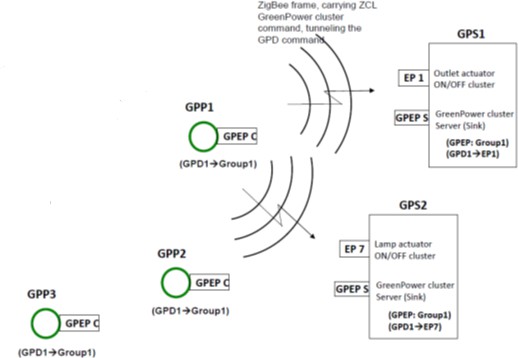
The following figure illustrates two GP infrastructure devices.
Green Power Proxy (GPP)
Receives and forwards the GPDF wrapped in a ZCL command over the Zigbee network. This is sometimes called tunneling the GPD command.
Receives the GPDF, hence a Server for GPDF frames.
Sends the ZCL tunnel commands to the GPS. This is a client role of GP Cluster in ZCL.
Green Power Sink (GPS)
Receives the tunneled commands and executes them.
Receives the ZCL tunnel commands from the GPP. This is a server role of GP Cluster in ZCL.
Note: Even though it is possible to implement a standalone GPS device with EmberZNet PRO with the limitation of in-range direct communication with a GPD, a Green Power Combo (GPC) is preferred over a standalone GPS. The reason is that stand-alone sinks are rare because the Z3 specification requires all the routers to be Proxy Basic at minimum. The following sections of this User Guide discuss how to implement a GP Combo (GPC) rather than a GPS.