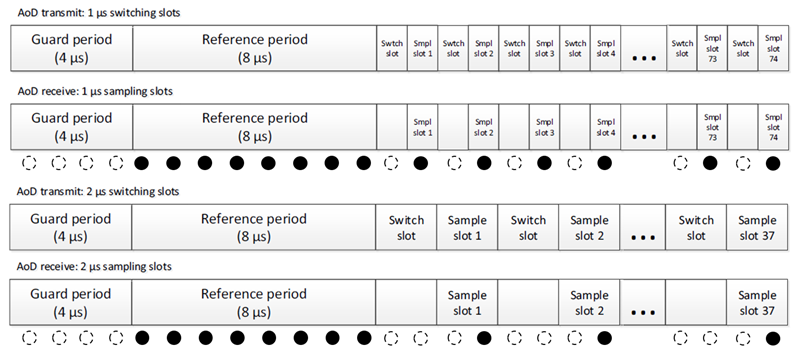
Angle of Arrival / Angle of Departure#
The previous sections primarily discuss the case of Angle of Arrival (AoA) method, where the transmitter sends a continuous wave on a single antenna, and the receiver samples the incoming signal on multiple antennas.
In the Angle of Departure (AoD) method, the antenna switching happens on the transmitter side, and the receiver samples the incoming signal on a single antenna. This, however, does not change anything on the structure and interpretation of the IQ samples. The fact that antenna switching happens on the transmitter side does not affect the result at all. The only difference is in the configuration. In the case of AoD the switching pins must be set up on the transmitter, and both the transmitter and the receiver must know the switching pattern. This contrasts with AoA, where the switching pattern need only be configured on the receiver side.