Z-Wave Overview#
Z-Wave Technology#
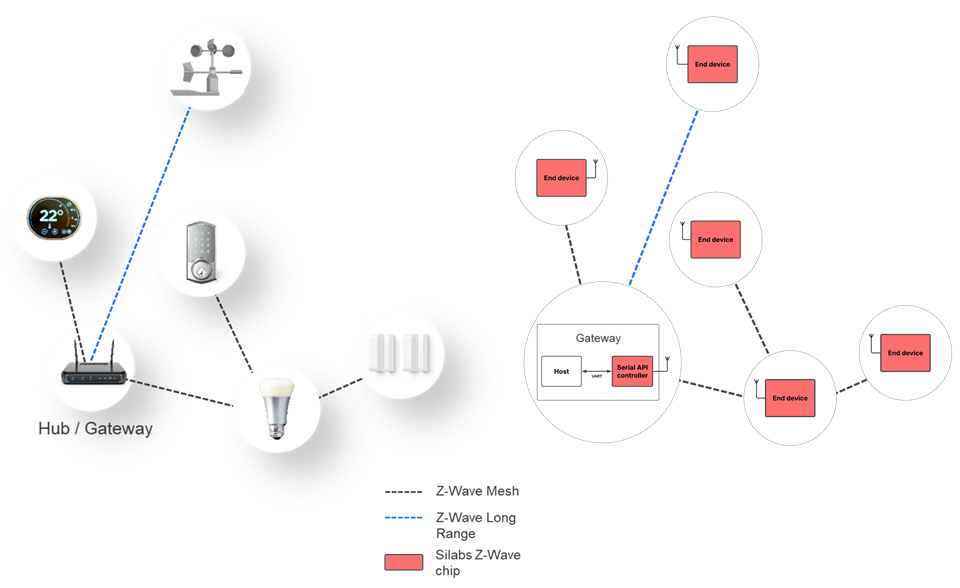
Z-Wave Technology is a leading wireless communication protocol designed for the Internet of Things (IoT). It provides reliable and secure data transmission with low energy consumption, ensuring full compatibility across various devices. Introduced in 2020, Z-Wave Long Range (LR) extends connectivity beyond the boundaries of the home, offering extended range and increased network capacity while maintaining compatibility with existing devices.
The table below highlights the key differences between Z-Wave classic and Z-Wave Long Range:
Feature | Z-Wave | Z-Wave Long Range |
|---|---|---|
Topology | Mesh network | Star network |
Network size | 232 nodes | 4000 nodes* |
Modulation | FSK, GFSK | DSSS OQPSK |
Max Output Power | US: -1 dBm; EU: +14 dBm | US: +30 dBm*; EU: +14 dBm |
Dynamic output power | No | Yes |
Data rate | 9.6 kbps; 40 kbps; 100 kbps | 100 kbps |
Beaming | Continuous beam (250 ms, 1000 ms) | Fragmented beam (~110 ms) |
Security | S0, S2: Unauthenticated, Authenticated, Access | S2: Authenticated, Access |
Inclusion Method | Classic inclusion; SmartStart | SmartStart only |
*These are the maximum values allowed by the standard. Silicon Labs’ implementation supports:
Z-Wave LR networks up to 1024 nodes
Z-Wave LR transmit power up to +20 dBm
Underlying Physical Layer and Packet Structure#
Network performance is based on payload sizing since the application usage does not account for the packet overhead. Z-Wave uses the ITU-T G.9959 standard with 64/170-byte MPDU packets at data rates of 9.6 kbps, 40 kbps, and 100 kbps, while Z-Wave Long Range uses 192 byte MPDU packets with fixed data rate of 100 kbps.
Z-Wave classic packet structure:

Z-Wave Long Range packet structure:

Topology Overview#
A typical IoT gateway/hub integrates Z-Wave functionality by using a Serial API controller, which is a Z-Wave chip with a serial interface for communicating with the host application processor.