


Overview of Zigbee Cluster Library (ZCL)#
Zigbee defines the MAC/PHY and Network layer standard and the application layer protocol - Zigbee Cluster Library. This training module focuses on the Zigbee Cluster Library. The specification is available for public download at csa-iot.org
Overview#
Cluster#
Represents a specific functionality through defined Attributes and Commands
Stresses a standardized message format for attributes and commands, which ensures interoperability that allows for ease of interoperable use between devices
Uses the “client” and “server” model of communication
Supports Manufacturer Extensions
Zigbee Cluster Library (ZCL)#
Is a repository for clusters for use in public profiles
The same cluster (and ID) can be used in multiple profiles
Attribute#
Key concepts in a cluster include data, messaging, and the direction of communication. An attribute is data associated with a cluster. Each attribute declares a 16-bit identifier, a data type, a read-only or read/write designator, a default value, and is supported by mandatory or optional.
The following table lists some of the attributes of the Temperature Measurement Cluster. The cluster server supports five attributes; the Tolerance attribute is optionally supported. These attributes are read-only, indicating that any write attempts to them will fail.
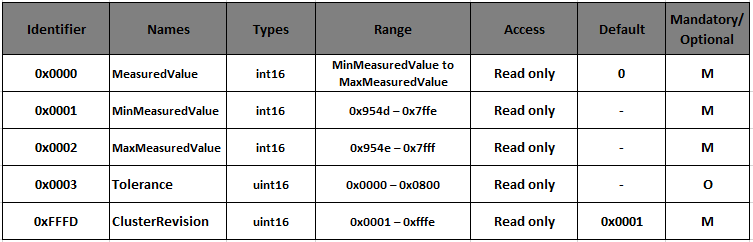
The Cluster Revision attribute is a global attribute introduced in revision 6 of the ZCL. The Global attributes are defined for every cluster instance on a device and function as standard ZCL attributes. This attribute is a way to version each cluster specification, improve backward compatibility, and allow testing of specific versioned cluster behavior. This Cluster Revision attribute is incremented for every major change to each cluster’s specification.
Command and Client-Server Model#
Commands are divided into two types according to their cluster scope: global and cluster-specific.
Global Commands are mainly used for manipulating the attributes (such as read, write and report attributes), and they are not specific to any cluster.
Cluster-Specific Commands are part of the cluster definition and include the payload format, support requirements (mandatory, optional), and behavior on receipt of a cluster-specific command. For example, the ZCL On/Off cluster defines three mandatory commands (OFF, ON, and TOGGLE) and several optional commands.
Each cluster has a distinction of a client and server side.
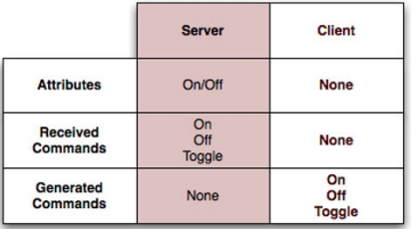
The server is the side that contains the Attributes. The client side is usually the one that reads and/or modifies the attributes. For example, in an On/Off cluster, the client side would typically be a switch that sends messages, such as on/off commands, to a server which would be a light. Being the server, the light would contain the On/Off attribute to indicate whether the device is on or off.
Manufacturer Extensions#
The ZCL allows extending the existing library in several ways. For example, users may add manufacturer-specific commands or attributes to existing clusters or define entirely new clusters that are manufacturer specific.
Manufacturer-specific commands are identified by setting a particular bit in the ZCL frame control and including the manufacturer code (received from the Zigbee Alliance) in the ZCL frame. This guarantees that manufacturer-specific extensions do not interfere with other manufacturer-specific extensions or existing ZCL clusters.
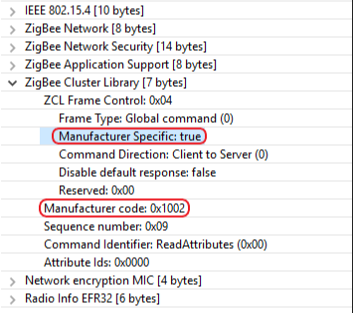
Manufacturer-specific clusters must use the cluster ID range of 0xFC00-0xFFFE.