


SiWG917 Energy Profiling#
This section lists the reference examples and the setup procedure used to measure the current consumption.
Reference Examples#
The following are the reference examples in the WiSeConnect SDK for configuring Power Save Modes:
| Scenario | Reference Examples | Configuration in reference example |
|---|---|---|
|
Lowest power consumption on M4, without active wireless |
Power Save Deep Sleep |
M4: Deepsleep/PS0 NWP: Deepsleep without Retention |
|
Both M4 and NWP in low power, while maintaining WLAN Connection |
Power Save Standby Associated |
M4: PS3 Sleep NWP: Associated Power Save |
|
Both M4 and NWP in low power, while maintaining socket connectivity via WLAN |
11n: Power Save Standby Associated TCP Client 11ax: TWT TCP Client |
M4: PS3 Sleep NWP: Associated Power Save with TWT |
Power Manager service in the wiseconnect SDK facilitates M4 Power State transitions, below are the reference examples for better understanding:
For various M4 Active state transitions, refer to Power Manager Wireless example.
For Tickless Idle Mode implementation usage, refer to Power Manager Tickless example.
Notes:
The current consumption details present in this section are measured using the Energy Profiler tool from Simplicity Studio IDE.
All the current consumption values mentioned in this section are measured with 352-320 KB memory configuration for NWP and M4 respectively.
A variation of current consumption by ±10% might be expected from board to board.
For the latest/updated current consumption numbers, refer to the SiWG917 data sheet.
Setup Diagram#
For measuring current, the following setup is used:
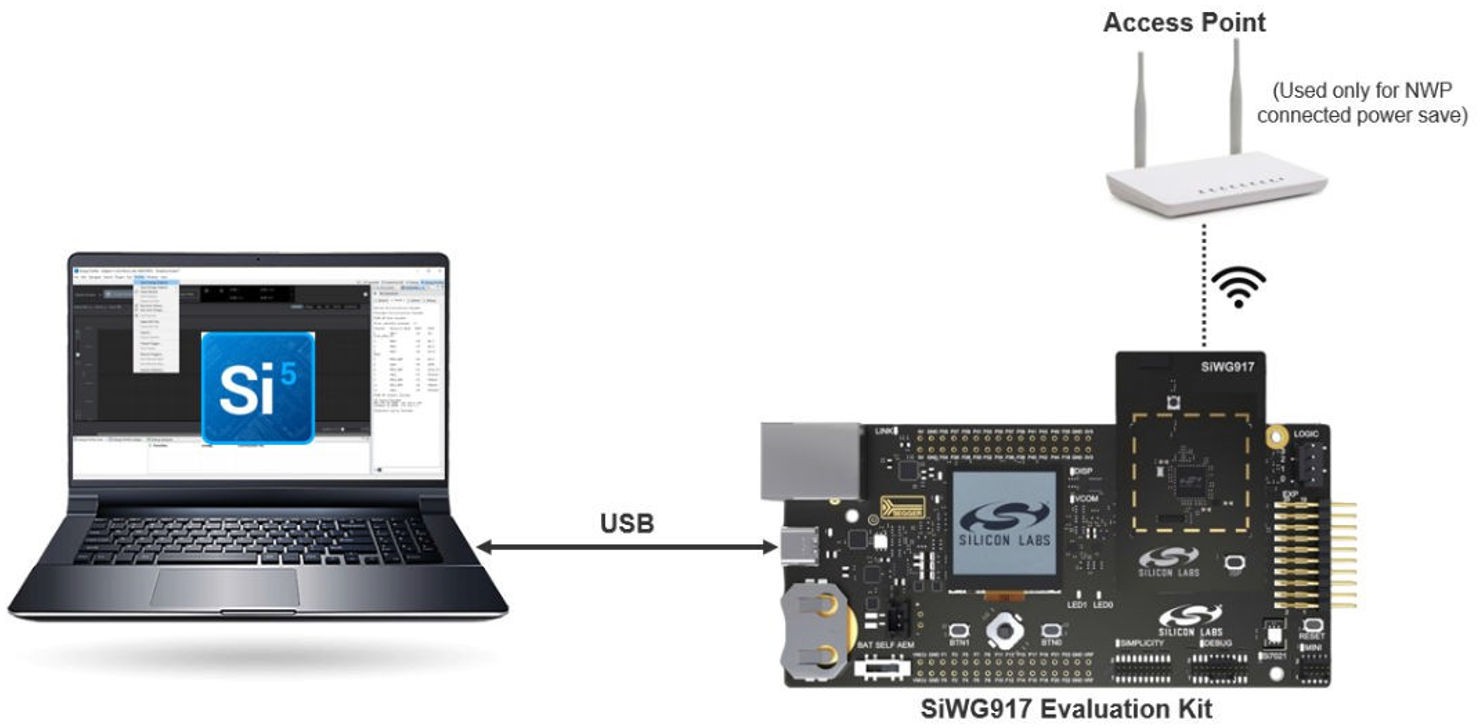
SiWG917 (M4+NWP) Power Consumption#
Power Save Standby Associated Example#
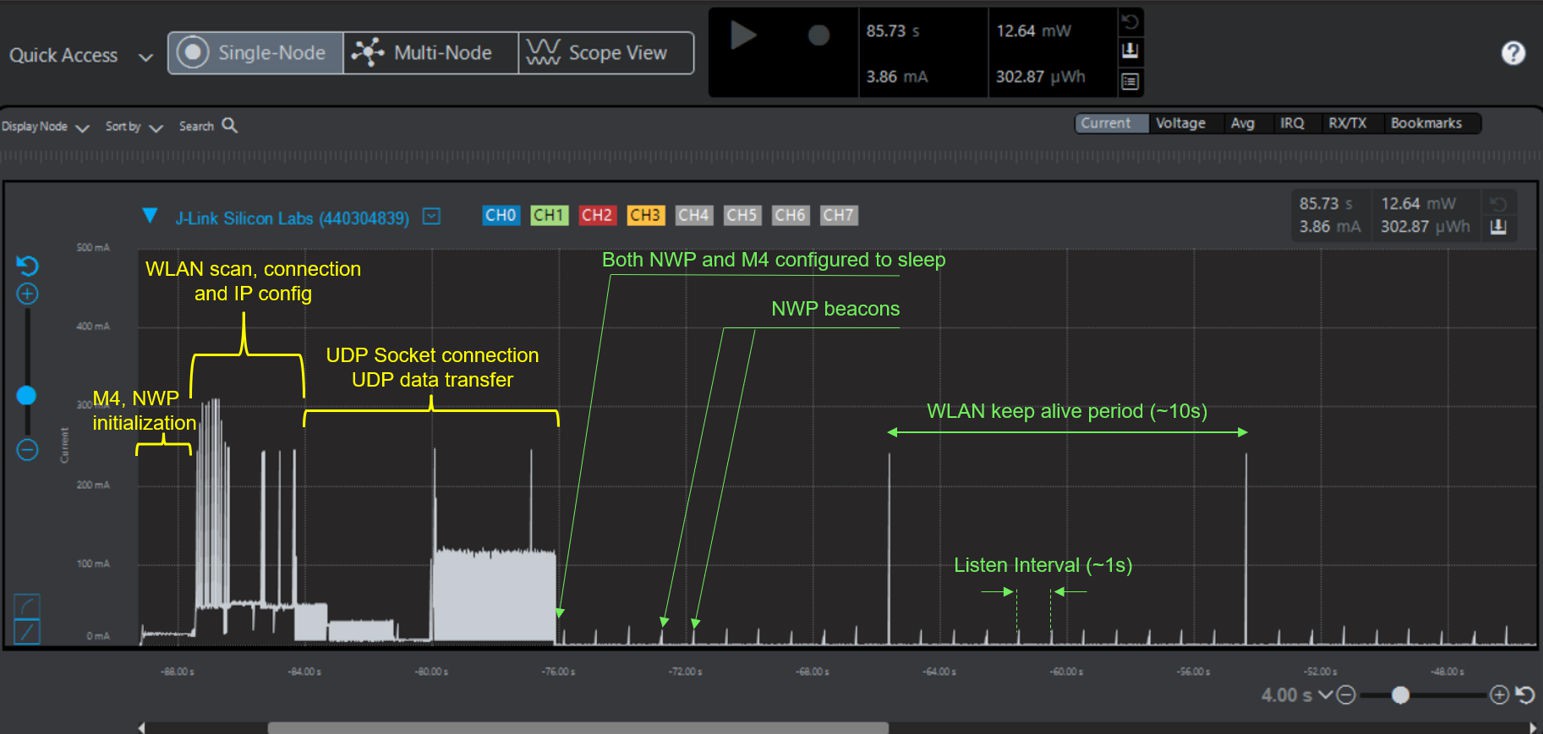
The Power Save Standby Associated example has the functionality below:
M4 and NWP are initialized.
NWP configured as WLAN station, connects to an Access Point and gets the IP address via DHCP.
By default, the applications are configured to scan on 2.4 GHz channels (1-11) for the specified SSID. The SoC sends a direct-ed Probe Request specifying the SSID it is looking for on the 2.4 GHz channels.
By default, the SoC sends a unicast probe request, gets a probe response, and then connects to the AP.
SoC connects to a UDP socket and performs data transfer with configured amount of data.
NWP is configured to Associated Power Save (Enhanced Max PSP).
M4 is configured to PS4 Sleep.
State
Average Current Consumption
Time Taken
SoC power-up to firmware load
15.93 mA
1.50 s
SoC power-up to radio initialization
15.94 mA
1.54 s
Radio initialization to wireless scan
61.5 mA
1.88 s
WLAN scan
56.5 mA
1.01 s
WLAN connection
59.8 mA
1.08 s
SoC power-up to IP configuration (Using DHCP)
47 mA
5.33 s
SiWG917 during WLAN Data Transfer
The NWP can be in the following atomic states:
TX_ACTIVE: Current consumption during active transmission at a given on-air data rate such as 6 Mbps, and a given output power level.
RX_ACTIVE: Current consumption during active reception at a given on-air data rate.
LISTEN: Current consumption when the NWP is waiting for data reception. The NWP current consumption values during data transfer, are mentioned in the WLAN 2 GHz section of the SiWG917 data sheet.
NWP in Associated Power Save and M4 in PS4 sleep current is mentioned in SiWG917 Typical Current Consumption section.
TWT TCP Client Example#
The TWT TCP Client example has the following functionality:
M4 and NWP are initialized.
NWP configured as WLAN station connects to the Access Point, and gets the IP address via DHCP.
SoC configured as TCP client, connects to a TCP server, using the credentials present in the application.
If the connected AP supports 11ax TWT, NWP is configured to 11ax TWT Associated Power Save.
If the connected AP does not support 11ax TWT, NWP is configured to 11n Associated Power Save.
Current numbers:
The current numbers from initialization to IP config are same as the Power Save Standby Associated example.
When NWP is in Associated Power Save with TWT and M4 is in PS4 sleep, the sleep current is as mentioned in WLAN 2 GHz section of the SiWG917 data sheet.
M4 in Sleep with Retention, NWP in Associated Power Save with TWT Enabled
By default, the TWT parameters configured in TWT TCP client example brings in a TWT Wake Interval of ~ 61 seconds.
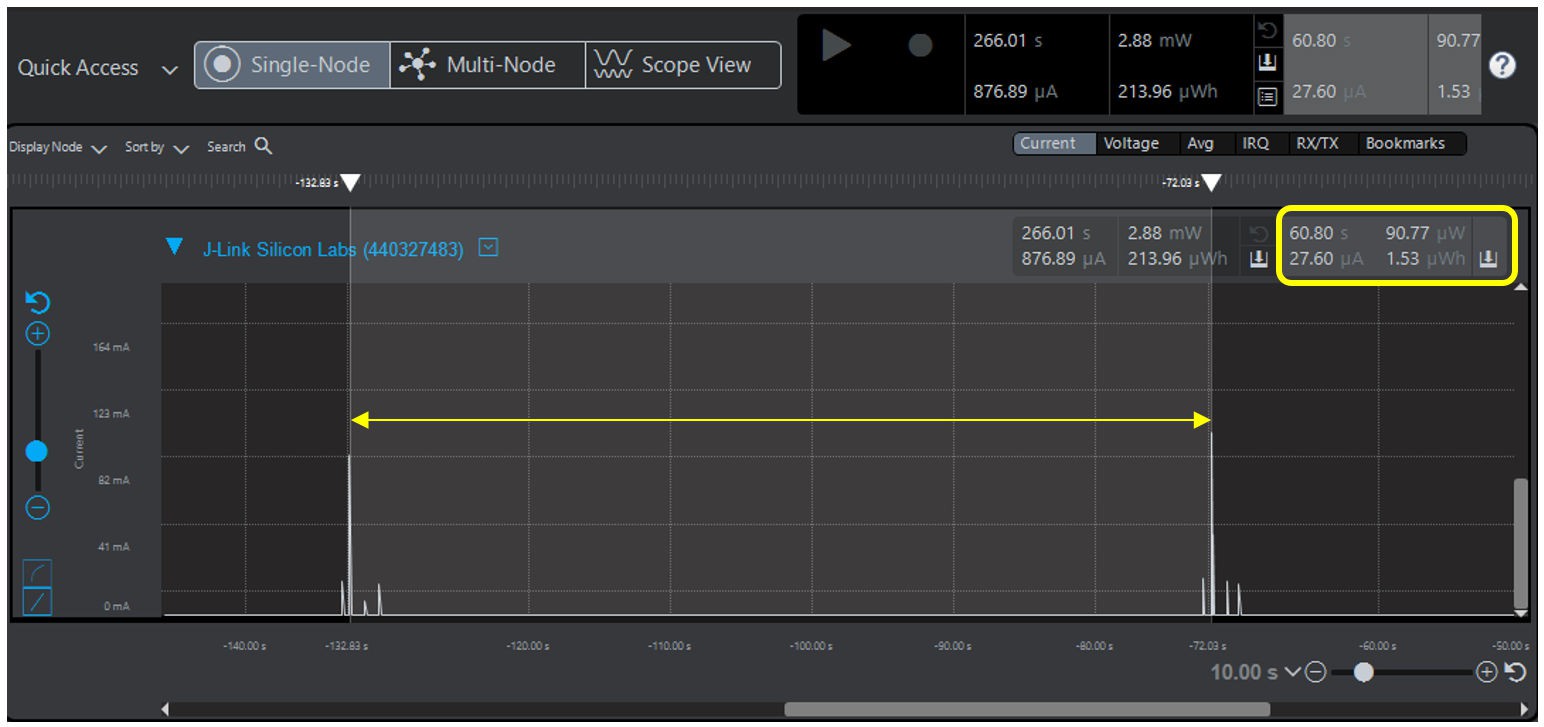
The current above consumption values are mentioned in the WLAN 2 GHz section of the SiWG917 data sheet.