


NCP Mode (Full Stack on NWP)#
In NCP (Network Co-Processor) mode, the full Bluetooth Low Energy (BLE) stack runs on the Network Processor (NWP), and an external host processor communicates with the NWP through SPI, SDIO, or UART interfaces.
NCP Mode Architecture#
NCP Architecture:
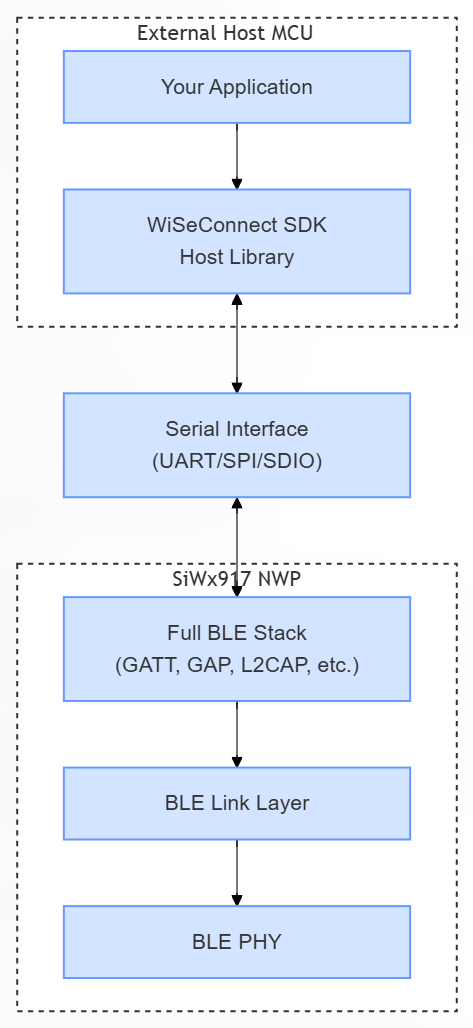
Component placement and interfaces:
Full BLE Stack: Runs entirely on the NWP
Host Interface: External host communicates through SPI/SDIO/UART
Host SDK: Host uses WiSeConnect SDK to communicate with NWP
Host Responsibilities:
Application logic
Host interface communication
Event handling and response
User/application API handling (calling BLE APIs from the host application through WiSeConnect SDK)
NWP Responsibilities:
Complete BLE stack (GAP, GATT, L2CAP, etc.)
LE Controller, Link Layer, PHY
Radio management
NCP Mode Characteristics#
Advantages:
Simplified Host: Host only needs to use WiSeConnect SDK
Full Stack Features: All BLE features available without host stack implementation
Firmware Updates: Stack updates through NWP firmware updates
Lower Host Requirements: Host doesn't need BLE stack implementation
Considerations:
Host Interface Overhead: Communication overhead for all BLE operations
Latency: Host interface adds latency to BLE operations
Throughput: Limited by host interface bandwidth
BLE Operations in NCP Mode#
API Usage:
All BLE APIs are available through WiSeConnect SDK host library
APIs are blocking or event-based depending on implementation
Host library handles serial interface communication and protocol conversion between application and NWP
Host Serial Interface Integration:
The WiSeConnect SDK uses a Hardware Abstraction Layer (HAL) pattern for serial communication
The host developer must implement HAL functions (for example,
sl_si91x_host_spi_transfer(),sl_si91x_host_uart_transfer()) using platform-specific serial drivers—these implementations are required for NCP mode; the SDK does not provide themThe SDK calls these HAL functions when it needs to communicate with the NWP
The host implements these functions in HAL files, mapping SDK calls to the host's SPI/UART/SDIO drivers
For the current list of HAL APIs to implement, see the Implement HAL porting step
Porting Requirements for NCP Mode: When porting WiSeConnect SDK to an external host MCU for NCP mode, the following steps are required:
Add WiSeConnect SDK to Application (Porting Steps: Add SDK):
Integrate WiSeConnect SDK components and required files from Simplicity SDK
Port compiler/architecture-specific functions (
CORE_EnterAtomic,CORE_ExitAtomic,CORE_EnterCritical,CORE_ExitCritical)Configure project build settings and include paths
Implement Hardware Abstraction Layer (HAL) (Porting Steps: Implement HAL):
Serial Interface Functions: Implement
sl_si91x_host_spi_transfer()and/orsl_si91x_host_uart_transfer()for data transferHigh-Speed Bus: Implement
sl_si91x_host_enable_high_speed_bus()if using SPI > 25 MHzGPIO Functions: Implement reset control (
sl_si91x_host_hold_in_reset(),sl_si91x_host_release_from_reset()) and sleep/wake indication for power-save functionality (sl_si91x_host_set_sleep_indicator(),sl_si91x_host_clear_sleep_indicator(),sl_si91x_host_get_wake_indicator())Interrupt Handlers: Implement
sl_si91x_host_enable_bus_interrupt()andsl_si91x_host_disable_bus_interrupt()for frame pending interruptsInitialization: Implement
sl_si91x_host_init()andsl_si91x_host_deinit()
Define CMSIS RTOS2 APIs (Porting Steps: Define RTOS APIs):
Port kernel management (
osKernelInitialize,osKernelStart,osKernelGetTickCount)Port thread management (
osThreadNew)Port synchronization primitives (
osMutexNew,osMutexAcquire,osMutexRelease,osEventFlagsNew,osEventFlagsSet,osEventFlagsWait)Port delay functions (
osDelay)Map to your RTOS implementation (FreeRTOS, ThreadX, etc.)
Define Preprocessor Macros (Porting Steps: Define Macros):
Required:
SLI_SI917,SLI_SI917B0,SLI_SI91X_MCU_CONFIG_RADIO_BOARD_VER2Optional:
SL_SI91X_SPI_HIGH_SPEED_ENABLE(for SPI > 25 MHz),SLI_SI91X_OFFLOAD_NETWORK_STACK(for network stack offload)
Reference: See Porting WiSeConnect SDK for an External Host - Overview and Porting Steps for complete porting guidance.
Event Handling:
BLE events received through host interface
Host application processes events and responds
Event callbacks are registered through the WiSeConnect SDK BLE callback registration APIs; see Callback Registration for the full set (GAP, GATT, SMP, and extended/advertising-extension callbacks)
Configuration:
BLE configuration through host interface commands
System configuration set during initialization
Runtime configuration through API calls
Reference: See NCP Mode Documentation for detailed NCP mode information.
APIs Used in This Section#
Topic | APIs / symbols | Reference |
|---|---|---|
Host HAL |
| |
Compiler portability |
| |
CMSIS RTOS2 (port) |
| |
Preprocessor macros |
| |
BLE (host library) | WiSeConnect SDK BLE APIs on the external host (see BLE API reference for entry points) |