


Introduction#
PTA is an external coexistence mechanism designed to mitigate packet collisions between devices using different protocols, such as THREAD, Wi-Fi, and BT/BLE. In this document's solution, the SiWx917 device is configured as the PTA Main, supporting PTA 3-Wire Co-Existence for Wi-Fi in the 2.4 GHz mode of operation. Concurrently, the BLE Device is configured as a PTA Secondary, operating in BLE mode. When both devices operate within the 2.4 GHz band, they may have overlapping channels due to their spatial co-location. To prevent this, specific synchronization between the BLE Device and SiWx917 is required to regulate their transmission and reception, ensuring no collisions occur and optimal performance is maintained.
As the PTA Main, the SiWG917 is responsible for deciding which of the two devices will transmit at any given time. This decision is based on handshake signals exchanged over three different GPIO connections between the BLE Device and the SiWG917. The BLE Device, acting as the PTA Secondary, triggers these handshake signals according to the packet transfer requirements of both devices.
The current implementation provides a capability that protects all BLE transmission/reception activities by ensuring no transmission interference from the SiWG917 in Wi-Fi mode. This mechanism also includes provisions to protect Wi-Fi transmissions from possible interference by the BLE Device. However, the current implementation does not ensure the protection of Wi-Fi reception, which will be addressed in future enhancements of this feature.
Radio Protocol Impact#
Globally, Wi-Fi (IEEE 802.11b/g/n) can support up to 14 overlapping channels of 20/22 MHz bandwidth within the 2.4 GHz ISM band, with transmit power levels reaching up to +30 dBm. Bluetooth, on the other hand, operates with 40 non-overlapping channels spaced at 2 MHz intervals, supporting transmit power levels up to +20 dBm, as specified in the Bluetooth Core Specification v5.0.
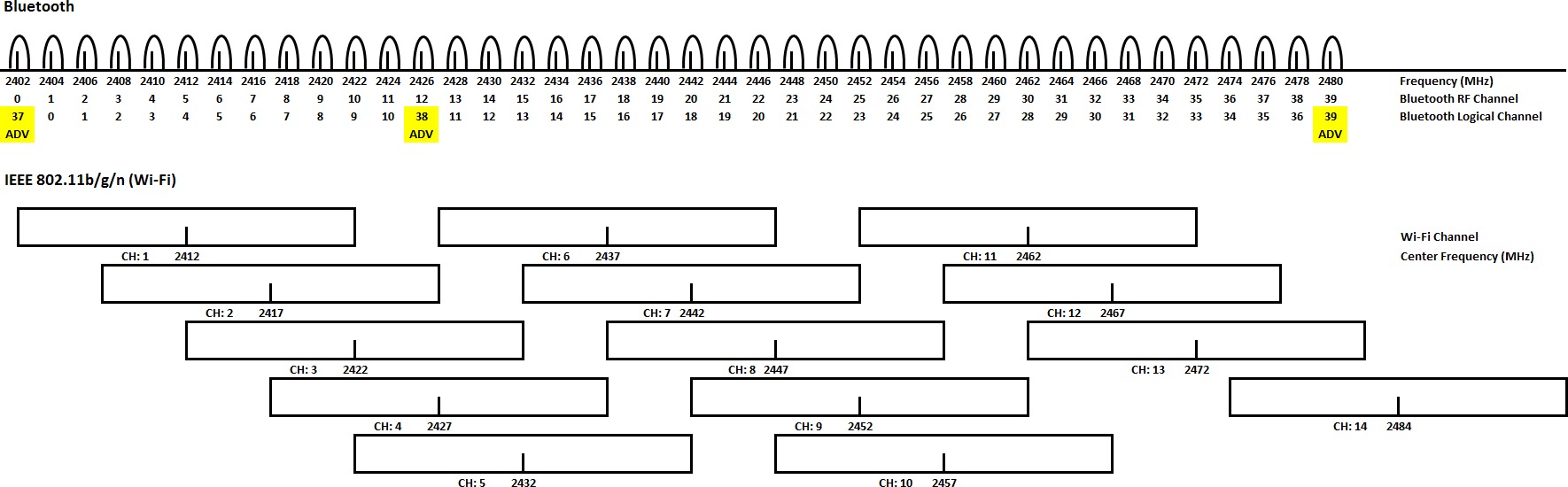
The number of available Wi-Fi Channels varies by country. For instance, in Japan, Wi-Fi channels 1 through 14 are available, while in the US, only Wi-Fi channels 1 through 11 can be used. Bluetooth operates 0 through 39 channels which are available globally.
PTA 3-Wire Co-Ex Mechanism#
PTA is an external coexistence mechanism designed to reduce packet collisions between devices using different protocols, such as THREAD, Wi-Fi, and BT/BLE. In the described solution, the SiWG917 acts as the PTA Main, controlling access to the spectrum for both itself and the BLE device based on three handshake signals.
The PTA 3-Wire Coexistence Mechanism consists of three signals implemented between the PTA Main (SiWG917 Wi-Fi) and the PTA Secondary (BLE device) are:
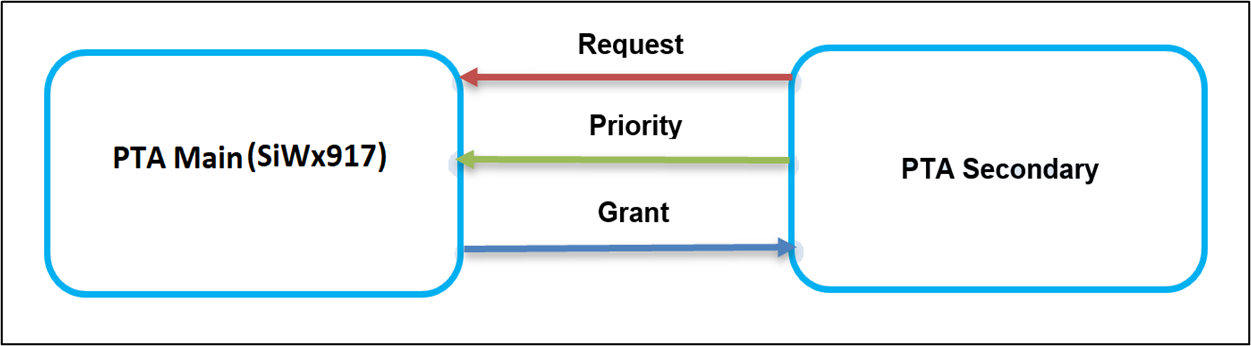
REQUEST
Input to SiWG917 and Output from BLE device.
The BLE device requests for channel access to the 2.4 GHz ISM band for transmission and reception.
Active high signal asserted by the EFR32 when it requires access to the radio.
PRIORITY
Input to SiWG917 and Output from BLE device.
The BLE device asserts priority to indicate priority traffic and request access to the 2.4 GHz ISM band for transmission and reception.
Active high signal asserted by the EFR32 to indicate that high-priority traffic requires radio access.
GRANT
Output from SiWG917 and Input to BLE device.
The SiWG917 grants permission to access the 2.4 GHz ISM band for transmission and reception.
Active high signal with a default state of high. The SiWG917 drives it low when it requires access to the radio.
For spectrum access to either transmit or receive, the BLE device asserts the REQUEST signal. Depending on the chosen configuration, the SiWG917 will indicate access by asserting the GRANT signal. The GRANT signal may only be asserted for spectrum access if the BLE device asserts both the REQUEST and PRIORITY signals, based on the configuration selected for the SiWG917.